Most safari visitors celebrate the moment they spot a leopard. Cameras click, excitement fills the air, and for a few magical minutes, everyone admires one of Africa’s most elusive predators.
But behind that calm, graceful appearance lies a life defined by relentless struggle.
Life as a male in the jungle is a struggle where every day is a battle for survival and dominance. Holding onto a territory is no small feat. A male leopard must constantly fend off rivals to protect his domain. Every confrontation leaves marks not only on his body but also on his spirit as he fights to keep intruders at bay and defend the land that offers food, shelter, and the opportunity to reproduce.
Yet territorial battles are only the beginning.
For every sunrise, a new challenge awaits.
The Mating Game: Winning Isn’t Guaranteed
For a male leopard, finding a mate is one of life’s greatest rewards but also one of its greatest challenges.
Female leopards only become receptive for a few days at a time. During this brief window, multiple males may compete for the same female, leading to tense confrontations that can quickly escalate into violent fights.
Victory is never certain.
The strongest male may secure the opportunity to mate, but maintaining that success requires constant vigilance. A rival male can appear at any moment, forcing another battle for dominance.
Even after mating, survival remains uncertain. If another dominant male takes over the territory, cubs fathered by the previous male may be killed, allowing the new ruler to pass on his own genes. It is a harsh reality, but one shaped by millions of years of evolution.
Nature rarely rewards weakness.
Honing the Hunt: Every Meal Must Be Earned
Unlike lions that hunt in prides, leopards work alone.
Every hunt depends entirely on stealth, patience, and perfect timing.
A male leopard may spend hours stalking unsuspecting prey through tall grass, rocky outcrops, or dense bushes. Sometimes he succeeds within seconds.
Other times, the hunt ends in failure.
In fact, many leopard hunting attempts are unsuccessful, meaning precious energy is lost with every missed opportunity. After making a kill, the challenge isn’t over.
Hyenas, lions, and even wild dogs constantly patrol the landscape looking to steal fresh kills.
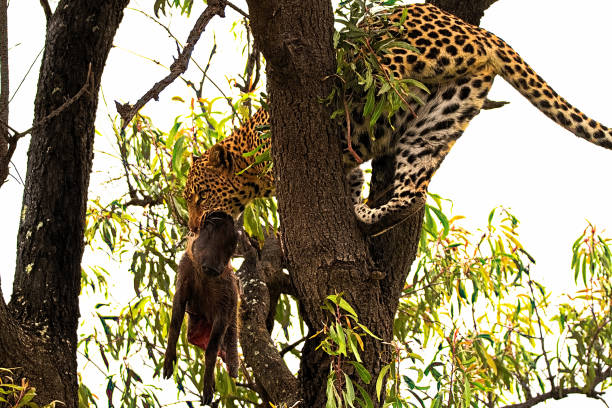
To protect his hard-earned meal, the leopard relies on one incredible advantage.
He drags prey sometimes weighing more than his own body high into the branches of trees, keeping it safely away from scavengers.
This remarkable strength is one reason leopards are considered among Africa’s most powerful predators pound for pound.
Displays of Dominance: More Than Just Fighting
Dominance isn’t only established through combat.
Male leopards communicate their presence across vast territories using scent markings, claw marks on tree trunks, and powerful vocal calls that echo through the night.
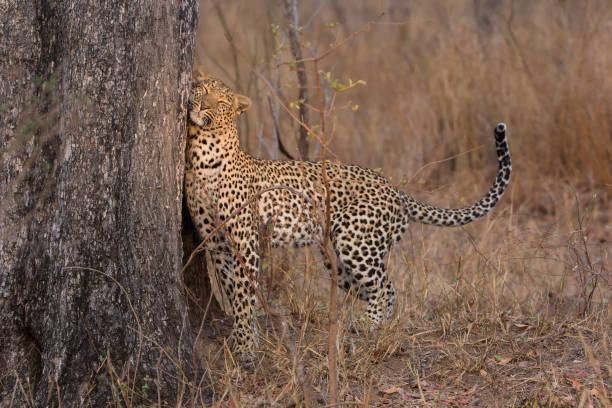
These silent messages warn competitors:
“This territory is occupied.”
The stronger and healthier a male appears, the less likely rivals are to challenge him directly.
But warnings don’t always work.
When territories overlap or food becomes scarce, confrontations become inevitable.
These encounters can leave permanent scars that tell stories of battles fought over years of survival.
The Solitary Struggle
Perhaps the greatest challenge of all is loneliness.
Unlike elephants that live in close family groups or lions that depend on pride members, leopards spend most of their lives alone.
Every decision rests on one individual.
Every hunt.
Every fight.
Every injury.
Every mistake.
There are no companions to defend territory, help locate food, or protect against danger.
A single serious injury can mean starvation.
A lost territory can mean the end of years of hard work.
Yet despite these overwhelming odds, male leopards continue to thrive across Africa because they have mastered one thing better than almost any other predator:
Adaptability.
Whether navigating forests, rocky mountains, savannahs, or even landscapes close to human settlements, leopards possess an extraordinary ability to survive where many other big cats cannot.
Why Seeing a Leopard on Safari Is So Special
Leopards are among the most elusive members of Africa’s Big Five.
Many visitors spend several days on safari without seeing one.
That is why every leopard sighting is unforgettable.
When you witness a leopard resting on a tree branch, silently stalking prey, or confidently walking through the bush, you’re not just observing a beautiful animal.
You’re witnessing the life story of a survivor that has overcome countless battles, endured endless challenges, and earned every inch of the territory beneath its feet.
It is one of nature’s greatest spectacles and one that leaves a lasting impression long after your safari ends.

Experience Kenya’s Incredible Wildlife with Tai Expeditions
Nothing compares to seeing a leopard in its natural habitat.
At Tai Expeditions, our expertly guided safaris take you into Kenya’s most iconic wildlife destinations, where every game drive offers the chance to witness remarkable moments that documentaries simply cannot capture.
Whether you’re exploring the legendary Maasai Mara, Amboseli National Park, Samburu National Reserve, or other breathtaking parks, every safari tells a story and every sighting becomes a memory you’ll treasure forever.
Book your next Kenyan safari with Tai Expeditions and discover the wild through the eyes of Africa’s ultimate survivor.